Ever since I was a child,
The word sacrifice puzzled me.
Adults spoke of it as if it were
the toll booth on the road to our dreams—
as though life demanded a payment of pain
before it would release its beauty.
Work hard.
Give something up.
Lose now so you may gain later.
Even then, something in me tilted its head.
The idea felt… inefficient.
Like trying to breathe while holding your breath.
At the same time, I heard other teachings—
friends speaking of sin and hell,
stories shaped from ancient texts
whose meanings had drifted like leaves
through centuries of interpretation.
But it was the language of sacrifice
that stayed with me.
As a child, I wondered:
Why would anyone teach a young being
that life requires loss
before it allows joy?
Unless
That story had simply been handed down
again and again—
whispered through generations
until it became the air of the culture itself.
A quiet program in the zeitgeist:
Nothing comes easy.
Dreams require suffering.
You cannot have everything you desire.
Yet even then,
another voice lived inside me.
Softer.
Quieter.
Like light through morning fog.
It said simply:
No… that isn’t real.
And still—
like many of us—
I drank the beloved red Kool-Aid of the culture
because everyone else was drinking too.
Yet I never lost track of that other voice.
It remained—
a small blue flame of knowing.
The Story We Were Given
Look around.
How many people on this planet
shape their lives around sacrifice?
Working five days to earn two.
Counting vacation days like rare coins.
Imagining that one day—
after decades of effort—
Life will finally begin.
The dream of retirement
as the promised land.
But for some of us
work is not something to retire from.
It is the current of creation itself.
I play.
I rest during my days.
Weekends become small retreats—
pockets of art, joy, contemplation.
This rhythm did not arrive overnight.
It unfolded slowly
as I practiced releasing the belief
That work must first be sacrifice
before it becomes fulfillment.
Because the moment we agree
that sacrifice is the price of creation,
we quietly accept a deeper story:
that we are limited beings.
Yet the world itself
teaches a different lesson.
Look to the ocean.
The forests.
The breath moving through your lungs.
We inhale oxygen.
We exhale carbon dioxide.
Plants do the opposite.
Where is the sacrifice here?
The Earth breathes
through a choreography of exchange.
Our bodies do the same.
Cells dissolve and regenerate.
Cycles unfold every seven years.
Life is a constant movement of giving and receiving.
The rhythm is effortless.
Why would our creative power
operate differently?
Unless someone told us so.
The Illusion of Loss
Consider the breath again.
Imagine deciding to keep the oxygen you inhale.
Holding it tightly—
refusing to exhale
because you fear losing it.
Your body would suffocate
under the weight of its own holding.
To live
requires release.
Giving creates space for receiving.
Yet sacrifice tells a strange story:
“I am losing something now
so that someday I may gain.”
It is a philosophy focused on absence—
a long meditation on loss.
Reciprocity tells another story entirely.
Giving is receiving.
Receiving is giving.
They are the same motion
viewed from different sides.
Sacred Reciprocity
I like to place a word before reciprocity:
Sacred.
Because it reminds me
that this exchange is not merely practical.
It is our nature.
To give something
you must first have it.
The moment you offer it—
a thought, a gift, a kindness—
you discover the abundance
already living within you.
The giving reveals the having.
And when something leaves your hands
it does not vanish.
It extends.
It multiplies.
It enters the great web of creation
and begins new journeys.
Imagine handing a child
a box of crayons and paper.
You give them a world.
They create another world.
Where is the loss?
Or imagine offering someone fifty dollars.
One perspective says:
“I am now fifty dollars poorer.”
Another sees differently:
“I just gave someone
the possibility of relief, food, or joy.”
Which story is true?
Both exist.
But only one
expands the field of creation.
Sacrifice focuses on what has left.
Reciprocity recognizes what is moving. what is expanding.
The Mathematics of Creation
Sacrifice says:
Lose now, win later.
Reciprocity says:
You are receiving as you give. You are always winning. There is no true loss.
It is the difference between a worldview
built on scarcity
and one rooted in generative flow. Abundance. Constant creation.
Because if you had something to give,
you already possessed it.
The giving simply revealed the abundance.
The deeper loss, perhaps,
is not the thing we release.
It is the power we forget
when we call giving a sacrifice.
Creation Without Martyrdom
Many traditions speak of sacrifice
as sacred ritual.
Yet somewhere along the way
the symbol hardened into a rule.
And the rule became a story
about suffering being necessary for creation.
But look again at nature.
Does the sun sacrifice its light
when it rises?
Do rivers sacrifice their water
when they flow?
Creation is not martyrdom.
Creation is overflow.
A champagne-gold radiance
spilling through the sky.
Blue clarity stretching across space.
Green life rising effortlessly from soil.
Violet mystery whispering
that more is possible than we imagine.
The universe does not create
through deprivation.
It creates through expression.
Learning the Rhythm Again
This does not mean
every desire must become form.
Wisdom sometimes reminds us
that imagination itself
is a kind of fulfillment.
Some creations belong in dreams.
Some belong in another season.
Some belong to the Great Mystery.
But when we give, teach, and share—
the field expands.
Teach someone to fish
and nourishment multiplies.
Teach someone to create
and entire worlds unfold.
When I teach,
I receive knowledge in return.
My students extend the teaching outward,
and through their lives
the gift returns again and again.
Creation is not a straight line.
It is a widening circle.
A Small Practice
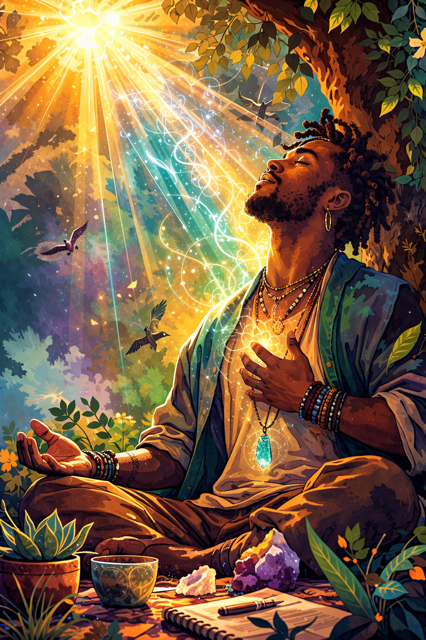
Close your eyes.
Place your hand
over the center of your chest.
Take three slow breaths.
Exhale through the mouth.
Feel the rhythm of your body—
the pulse of life
moving through your heart.
Imagine a soft field of color
around you:
champagne gold
with hints of green and blue.
A quiet atmosphere of reciprocity.
Notice that you are breathing with it.
Receiving.
Giving.
Receiving.
When you open your eyes
sit with one gentle question:
What is true for me?
Your answers
have always lived within you.
 indieHealer
Leave a comment